
A good pistachio spread feels smooth, releases its flavour readily, and glides across bread without leaving a waxy coating in the mouth. That texture depends on the balance between liquid oil, solid fat, fine particles, and cooling. Together, they form the fat system.
Define the eating experience
A useful development target is a soft, easily spooned spread at 20–25°C and a flowing topping at 30–35°C. These are design targets, not universal specifications.
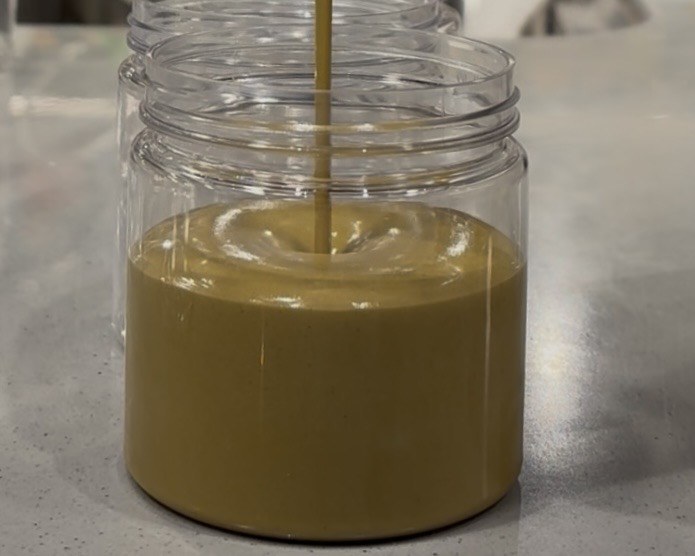
Creaminess and pourability are different properties. A spread may feel smooth while holding its shape on a spoon. Drizzling requires it to flow under little force and form a continuous ribbon. Warming helps, but particles can still resist flow even after much of the solid fat has melted.
Understand what is inside the jar
A conventional low-moisture spread is a suspension of pistachio solids, sugar, skim milk powder, and other dry ingredients in a continuous fat phase. Skim milk powder contributes mainly milk solids and very little fat; it should not be counted as a major source of liquid fat.
Pistachios supply much of the oil. For example, 55% pistachio paste containing 50% fat contributes 27.5% fat to the finished spread before added oil or stabilizing fat. This is an illustrative calculation; use the paste’s actual specification.
Consider an example using pistachio paste, tapioca dextrose, skim milk powder, sunflower oil, a stabilizing fat, lecithin, and salt. The paste and sunflower oil supply most of the liquid fat, while the stabilizing fat controls part of the structure. Skim milk powder adds dairy flavour, protein, and lactose, but also increases the particles that must be wetted and dispersed. Its contribution to creaminess depends on the complete formulation and refining.
Balance movement and structure
Liquid oil lubricates particles and generally improves movement. Too much can dilute pistachio flavour and increase the mobile oil the structure must retain.
A suitable network of fat crystals provides body and helps restrain that oil. Too little effective structure can allow separation; too much can make the spread stiff or waxy. The challenge is to retain enough structure for stability while keeping the product pleasant to spoon and eat.
Ask suppliers for the solid fat content curve, or SFC: the proportion of fat remaining solid at different temperatures. A single melting-point number cannot describe the whole texture. Evaluate the complete blend, including pistachio oil, rather than the added fat alone. [1] [2]
Design the transition from spread to drizzle
Cocoa butter or palm kernel stearin may help create a stronger temperature response, but simply adding harder fat can make the spread firmer at room temperature.
A useful trial may replace part of an existing stabilizer with a fat that loses more structure over the desired warming range, while rebalancing liquid oil and solids. Confirm the result in the finished recipe.
Cocoa butter and palm kernel stearin are not interchangeable. Their composition and crystallization differ, and mixtures can show non-linear softening. Compatibility needs testing, especially when lauric palm kernel fats are combined with cocoa butter. [3]
Refine for smoothness

Fat cannot hide coarse sugar, skim milk powder agglomerates, or inadequately refined pistachio particles. Finer grinding improves smoothness, but does not always increase fluidity: it also changes particle surface area and interactions with fat. Assess smoothness and flow together. [4]
Lecithin can help particle wetting and flow. Its useful level depends on the recipe; it cannot replace refining or guarantee protection against oil separation. [2]
Let the structure develop
A warm sample does not reveal the final texture. Record product temperature, mixing, filling, and cooling conditions so successful results can be reproduced.
Compare samples after 24 hours, 48 hours, and seven days at consistent storage conditions. These are development checkpoints, not shelf-life validation. Test spreadability and flow after the sample’s centre reaches the intended use temperature.
If the spread is smooth but too firm, investigate both fat structure and particle concentration. If it remains thick when warmed, examine particle interactions as well as remaining solid fat. Surface oil points to an oil-retention problem; a waxy finish suggests reviewing the melting profile. Each observation is a clue, not a diagnosis.
Keep a control batch and change one main factor at a time. Look for oil separation, firmness, grittiness, waxiness, and flavour release. A creamy pistachio spread emerges when oil, crystals, particles, and processing work together.